

Tentative Peace
Key Points:
US and Iran sign a memorandum of understanding (MOU) to reopen the Strait of Hormuz
The Reserve Bank of Australia (RBA) kept rates on hold at 4.35% in June
The beginning of a new financial year brings changes to income taxes, paid parental leave and superannuation
The US and Iran agreed to cease hostilities and reopen the Strait of Hormuz to pre-conflict levels. The two nations agreed on a 60-day window for further talks. Oil prices subsequently retreated to just shy of levels when the conflict began.
Although commodity markets have largely priced in a lasting easing of the conflict, negotiations remain vulnerable to setbacks, as demonstrated by renewed clashes following the announcement of the MOU.
The RBA kept the policy rate at 4.35%, following three consecutive interest rate rises.The Board's primary focus is ensuring the oil price spike does not translate into persistently higher inflation.
The start of a new financial year introduced a raft of new changes:
Income Taxes - the tax rate for taxable incomes between $18,001 and $45,000 per year will fall from 16% to 15%. Individuals earning above $45,000 per year will save $268 annually.
Payday Superannuation - Businesses will now pay superannuation on payday rather than in quarterly instalments.
Paid Parental Leave - Caregivers now have an additional two weeks of paid parental leave to 26 weeks.
Superannuation tax rate - Superannuation balances above $3 million now incur an additional 15% tax. Balances above $10 million incur a further 10% tax.
As always, please reach out to your advisor should you wish to discuss the contents of this report further.
Please click here to read our June 2026 markets report as a PDF.
Australian Economy
The Reserve Bank of Australia held rates on hold at 4.35% in June following three consecutive rate rises. The board is squarely focused on ensuring inflation “does not become embedded once the impulse from higher oil prices has passed through”.
To that end, underlying inflation increased to 3.6% in May. Housing inflation was the main contributor, reflecting higher rents, electricity and building costs.
The central bank noted that softer consumer spending and higher unemployment showed the economy was slowing. However, it kept the door ajar to further rate rises should inflation not moderate.
The Australian economy grew just 0.3% in March 2026 and 2.5% in the past 12 months. Household spending on essentials increased 0.8%, whereas spending on discretionary items rose just 0.1%, weighed down by higher interest rates and the expiry of energy subsidies.
Auction clearance rates plummeted in June as homebuyers digested the Federal Government’s changes to taxation. Capital city clearance rate fell to 49.2%. That compares to 67.9% one year earlier.
The large fall indicates a growing chasm between the expectations of sellers and buyers. Sellers are also holding off or cancelling auctions, with listings 13.4% lower than a year earlier.
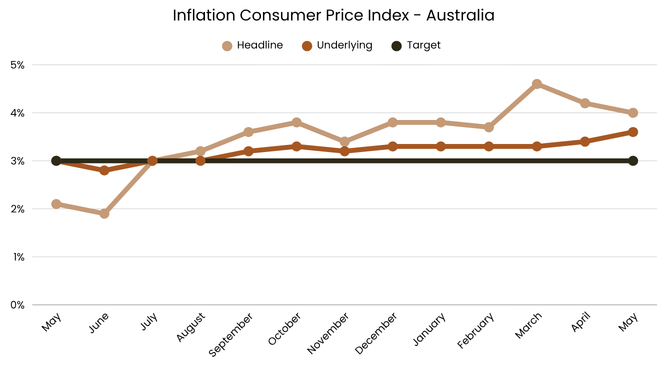
Data Source: Australian Bureau of Statistics
Equities
Equity market performance varied in June. Investors cooled on artificial intelligence-led enthusiasm, with the US declining 1.1%. Hong Kong retreated 9.1%, while South Korean markets entered a series of trading halts as chipmaker volatility spiked.
Conversely, the more industrial-focused Europe gained. China, Japan and India also recorded small gains. Overall, the MSCI World (ex-Australia) Index fell 0.8%.
The S&P/ASX 200 gained 0.5% in June, buoyed by a resurgence in healthcare and consumer sectors. Conversely, energy and materials unwound previous gains given the decline in commodity prices.
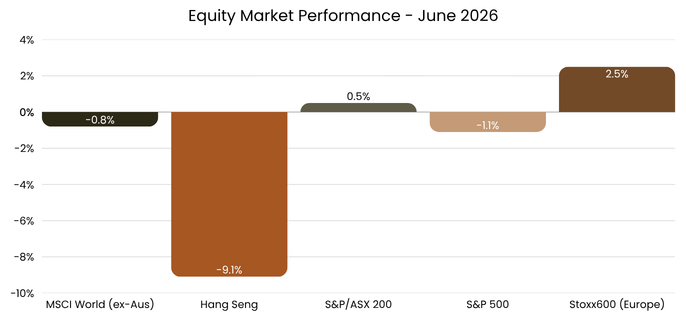
Data Source: TCorp
Fixed Income
The US Federal Reserve welcomed its new Chairman, Kevin Warsh, who left the policy rate unchanged at 3.50-3.75%. However, projections revealed participants expect a rate rise later this year
in response to strong employment data and continued inflation strength. Both European and Japanese central banks raised policy rates to combat rising inflation.
Australian government bond yields fell in June as RBA commentary indicated a lower chance of further rate hikes. 3-Year Commonwealth Government Securities fell 12 basis points to 4.36%. The 10-Year counterpart fell 11 basis points to 4.72%.
Currencies
The US dollar was the standout performer in June, rallying strongly following the US-Iran peace agreement. Expectations that the Federal Reserve would raise interest rates later this year also boosted the currency's appeal to income-seeking investors.
The Australian dollar lost ground against all major trade partners as markets revised expectations for future interest rate increases lower.
After posting several months of gains, the trade-weighted index retreated to April levels. That means imports are relatively more expensive, adding to domestic inflationary pressures.
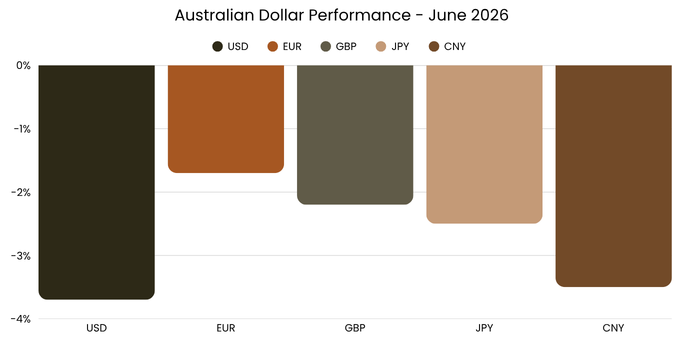
Data Source: Western Australia Treasury Corporation
Commodities
Oil prices continued to fall, closing at US$73 per barrel. Despite the unpredictable nature of peace talks and intermittent strikes, markets quickly priced in a potential increase in supply as Gulf producers rushed to clear existing stockpiles. However, only around 30–40 ships are passing through daily, compared with 130–140 before the conflict.
Gold declined to just above US$4,000 per ounce as easing geopolitical tensions and a firmer US dollar reduced demand for safe-haven assets. Higher global interest rates also continued to weigh on gold's relative attractiveness.
General Advice Disclaimer: The information and opinions within this document are of a general nature only and do not consider the particular needs or individual circumstances of investors. The Material does not constitute any investment recommendation or advice, nor does it constitute legal or taxation advice. Zuppe International Pty Ltd (ABN 12 628 405 952)
(The Licensee) does not give any warranty, whether express or implied, as to the accuracy, reliability or otherwise of the information and opinions contained herein and to the maximum extent permissible by law, accepts no liability in contract, tort (including negligence) or otherwise for any loss or damages suffered as a result of reliance on such information or opinions.
The Licensee does not endorse any third parties that may have provided information included in the Material. Past performance is no guarantee of future results and current performance may be higher or lower than the performance shown. Therefore, any stated figures should not be relied upon. The investment return and principal value of an investment will fluctuate so that an investor’s investments, when redeemed, may be worth more or less than their original cost.
