

Tax Reform
Key Points:
The Federal Budget announced meaningful changes to capital gains tax, negative gearing and trusts
Oil prices slumped in May as it appeared the US and Iran would reach an agreement
Equities rallied strongly on artificial intelligence enthusiasm, bond yields fall as inflation fears abate
Markets build on April’s resurgence as investor fears over a prolonged Middle East conflict dimmed. Oil prices retreated as the US and Iran were close to securing a permanent ceasefire and the opening, at least partially, of the Strait of Hormuz. Equities rallied strongly on artificial intelligence enthusiasm, while bond yields fell as inflation fears abated.
The Reserve Bank of Australia upped the cash rate for a third consecutive meeting to 4.35%, unwinding all of the 2025 rate cuts. Except for 2025, interest rates have not been this high since 2011.
The Federal Budget for 2026-27 announced a series of policies aimed at addressing the taxation of income versus assets. Key policy changes include:
A 30% minimum tax on capital gains will be introduced from 1 July 2027, replacing the existing 50% capital gains discount.
A 30% minimum tax on trusts will come into effect from 1 July 2028
Negative gearing to be restricted to new home builds
The policies have not yet been legislated, so we await further detail and consultation before advising on the best path forward.
As always, please contact your advisor if you would like to discuss how these changes may affect your circumstances.
Please click here to read our May 2026 markets report as a PDF.
Australian Economy
The Reserve Bank of Australia approved a third consecutive interest rate rise. The monetary policy board voted 8-1 to increase the policy rate 25 basis points to 4.35%, erasing all of the policy easing of 2025.Minutes released after the meeting revealed the board would likely hold the rate in the immediate future to assess the impact.
Inflation retreated marginally in April to 4.2%, down from 4.6% in March. The retreat is largely down to a slower annual increase in petrol prices, which rose 18.6% in April compared to 24.2% in the 12 months to March.
The unemployment rate increased to 4.5%, its highest point since 2021. Total employment decreased by 19,000. Moreover, the number of unemployed increased by 33,000.
National home prices were flat in May, with capital cities falling marginally. Rate hikes and the recent budget changes will likely continue to subdue activities in the coming months. Still, house prices have increased 8.8% across the past 12 months.
Consumer confidence rebounded after a sharp decline in April following the oil price shock. The halving of fuel excise tax has alleviated some pain, but overall, consumers are downbeat on the economy.
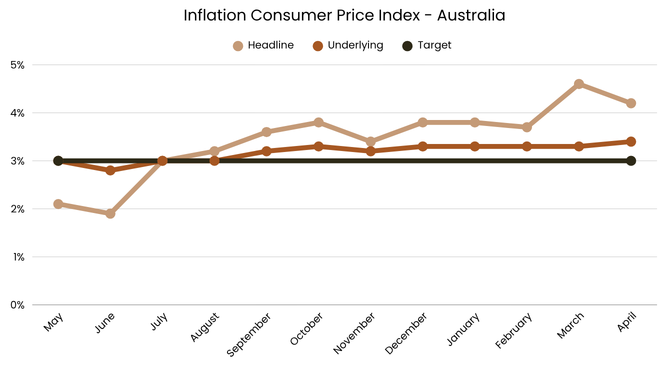
Data Source: Australian Bureau of Statistics
Equities
Equity markets built upon their April gains as investors rode higher on the artificial intelligence enthusiasm. MSCI World (ex-Australia) Index added 4.4% and has now entered positive territory for 2026. Japan was the standout performer, with semiconductor and other AI-related companies rising. US stocks, notably NVIDIA, also rallied on robust earnings results.
With our relatively smaller exposure to artificial intelligence companies, the S&P/ASX 200 inched 0.8% higher. Materials continue to post strong gains buoyed by higher commodity prices. Conversely, healthcare, which includes the likes of CSL and Cochlear, continues to be a source of disappointment.
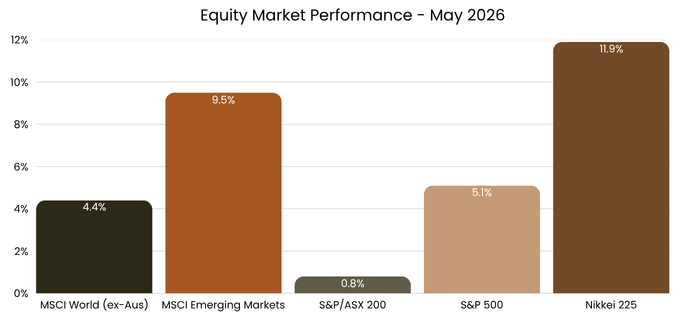
Data Source: TCorp
Fixed Income
After several months of strength, global bond yields largely declined in May in line with oil prices. The prospect of a resolution in the Middle East eased concerns of a global inflation spike and therefore the likelihood of higher interest rates. The Australian 10-year Government Bond yield finished 23 basis points lower to 4.84%.
In contrast, US 10-year Treasuries gained 6 basis points to 4.44% as economic data indicated the economy was not slowing down. Japanese bond yields also gained.
Currencies
Despite intra-month volatility, the Australian dollar finished largely unchanged against trade partners.
The AUD strengthened upon news of the third consecutive rate rise, but reversed the gains when minutes showed the monetary policy board would likely pause to assess the impact of the hikes.
Interestingly, the trade-weighted index reached a nine-year high during May. This means imported goods became relatively cheaper for Australian businesses (and ultimately consumers), helping to buffer inflation.
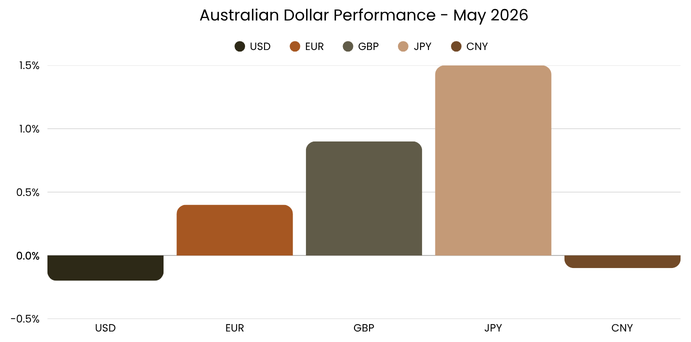
Data Source: Western Australia Treasury Corporation
Commodities
Commodities took a backward step in May. Oil prices retreated 19.3% to US$92 per barrel as optimism grew around the reopening of the Strait of Hormuz. Prices are still well above the ~US$60 per barrel pre-conflict. Elsewhere, base metals such as copper and aluminium gained on continued demand for electrification.
Gold retreated marginally, continuing its descent as rising bond yields weigh on investor appeal. Gold is relatively less attractive as a store of value when investors can earn interest in low-risk assets such as government bonds.
General Advice Disclaimer: The information and opinions within this document are of a general nature only and do not consider the particular needs or individual circumstances of investors. The Material does not constitute any investment recommendation or advice, nor does it constitute legal or taxation advice. Zuppe International Pty Ltd (ABN 12 628 405 952)
(The Licensee) does not give any warranty, whether express or implied, as to the accuracy, reliability or otherwise of the information and opinions contained herein and to the maximum extent permissible by law, accepts no liability in contract, tort (including negligence) or otherwise for any loss or damages suffered as a result of reliance on such information or opinions.
The Licensee does not endorse any third parties that may have provided information included in the Material. Past performance is no guarantee of future results and current performance may be higher or lower than the performance shown. Therefore, any stated figures should not be relied upon. The investment return and principal value of an investment will fluctuate so that an investor’s investments, when redeemed, may be worth more or less than their original cost.
