

Perspective Matters
The Iran conflict dominated both markets and headlines in March, as investors grappled with the uncertainty surrounding a potential global oil shock.
Attention centred on the Strait of Hormuz, a narrow but critical waterway in the Persian Gulf through which roughly 20% of the world’s oil and gas supply passes.
With Iran effectively closing the Strait, nations moved quickly to release strategic reserves and secure essential supplies of diesel and gasoline.
Key Points:
The Iran war dominated market attention, with equities and fixed income markets retreating
The Reserve Bank of Australia raised the cash rate for the second month by 25 basis points to 4.10%
Global bond yields rise in anticipation of tepid economic growth and higher interest rates
This disruption has underscored the heavy reliance of many economies, including Australia, on imported refined fuels. The impact has also extended beyond energy markets into key industrial inputs such as fertilisers, affecting sectors including construction, agriculture, and consumer goods. As a result, both equity and fixed income markets experienced meaningful declines.
Periods when markets are dominated by a single event or headline often create opportunity. While many attempt (often unsuccessfully) to predict how such situations will unfold, our approach remains grounded in the facts.
We maintain a long-term perspective, focusing on the assets and investments that support sustainable wealth creation over time. The key message for clients is to stay disciplined with your investment strategy and approach headlines with a balanced perspective.
Equity markets for example, have recorded only minor declines over the past 3 months. Of course, please reach out to your advisor if you’d like to discuss recent market movements further.
Please click here to read our March 2026 markets report as a PDF.
Australian Economy
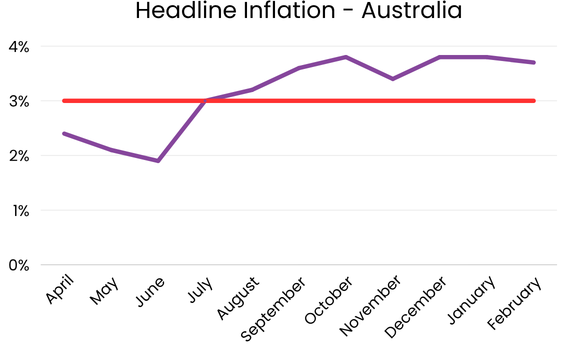
The Reserve Bank of Australia delivered a second consecutive rate hike, lifting the cash rate by 25 basis points to 4.10%. Notably, the monetary policy board split 5-4, indicating contention from certain members.
With inflation remaining above the target range since July last year, the move to tighten policy was widely expected. Geopolitical tensions, including the Iran conflict, have further heightened concerns about prolonged inflation, prompting the RBA to move early rather than risk falling behind
Data Source: Australian Bureau of Statistics
In doing so, the likelihood of a domestic recession rises. Cost of living is the dominant source of household stress, rising to the highest point since mid-2014.
Businesses are also under pressure, particularly those dealing in products and commodities, as rising costs continue to bite. Reece Plumbing reported a 36% increase in plastic pump prices in March.
The outlook for the economy may not look particularly encouraging. That said, unemployment remains low at just 4.3%, with wage growth resilient. The May budget should also aid the inflation fight via cost of living relief, and possibly even structural reform regarding tax, energy and/or housing policy.
Equities
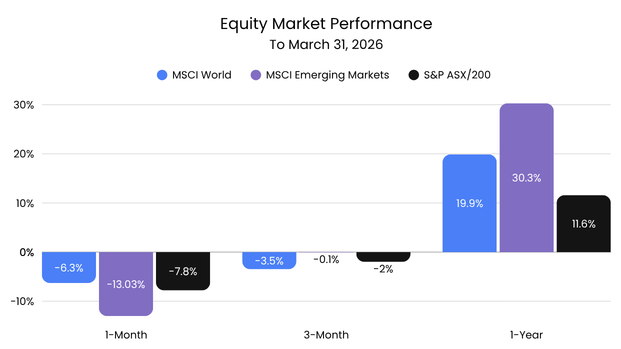
Equities experienced a notable pullback in March as short-term investors shifted away from risk assets. Emerging markets led the losses, followed by countries heavily reliant on energy imports, including Japan (-13.2%) and India (-11.2%).
The Australian market declined by 7.8%. Although Australia is a net energy exporter, this advantage was offset by its dependence on importing refined oil products such as diesel and gasoline.
Data Source: MSCI, S&P
Taking a broader view, the overall decline in equities has been relatively modest.
The key takeaway is to maintain a long-term view rather than reacting to short-term news headlines or daily market movements.
Fixed Income
Bond yields rose across the board in March as investors priced in the prospect of higher global inflation (and therefore higher interest rates) as a result of the Iran war supply-side shock.
Recall when bond yields increase, bond prices fall. Australian Government 10-Year bonds increased 32 basis points to 4.65%. Overseas US 10-Year treasuries appreciate 38 basis points to 3.94%.
Currencies
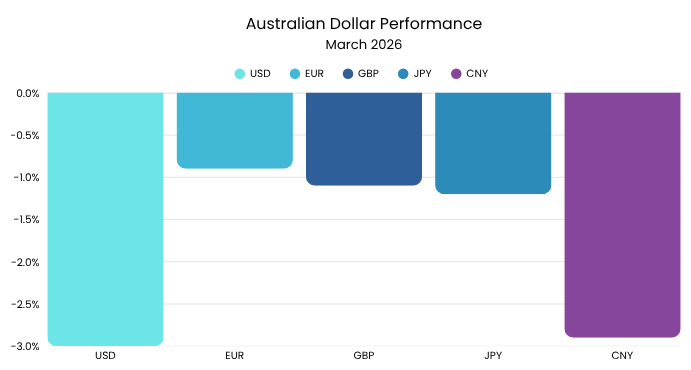
The Australian Dollar declined against most major currencies in March as it became clear the Iran War would weigh on global economic activity. The combination of two consecutive rate hikes and a lower-than-expected March inflation report also tempered expectations of further RBA intervention.
The AUD finished at US$0.69 against the US Dollar.
Data Source: Western Australia Treasury Corporation
Commodities
The destruction of energy infrastructure, coupled with the closure of the Strait of Hormuz, kick-started market fears of a global oil shortage. Benchmark US oil futures surged over 51%. Closer to home, the Singapore gasoil surged over 114% in local currency terms.
Despite volatility rising meaningfully, gold prices retreated amid a surging US dollar and investor deleveraging. The prospect of higher interest rates in response to inflation also weighed on the precious metal.
General Advice Disclaimer: The information and opinions within this document are of a general nature only and do not consider the particular needs or individual circumstances of investors. The Material does not constitute any investment recommendation or advice, nor does it constitute legal or taxation advice. Zuppe International Pty Ltd (ABN 12 628 405 952)
(The Licensee) does not give any warranty, whether express or implied, as to the accuracy, reliability or otherwise of the information and opinions contained herein and to the maximum extent permissible by law, accepts no liability in contract, tort (including negligence) or otherwise for any loss or damages suffered as a result of reliance on such information or opinions.
The Licensee does not endorse any third parties that may have provided information included in the Material. Past performance is no guarantee of future results and current performance may be higher or lower than the performance shown. Therefore, any stated figures should not be relied upon. The investment return and principal value of an investment will fluctuate so that an investor’s investments, when redeemed, may be worth more or less than their original cost.
